


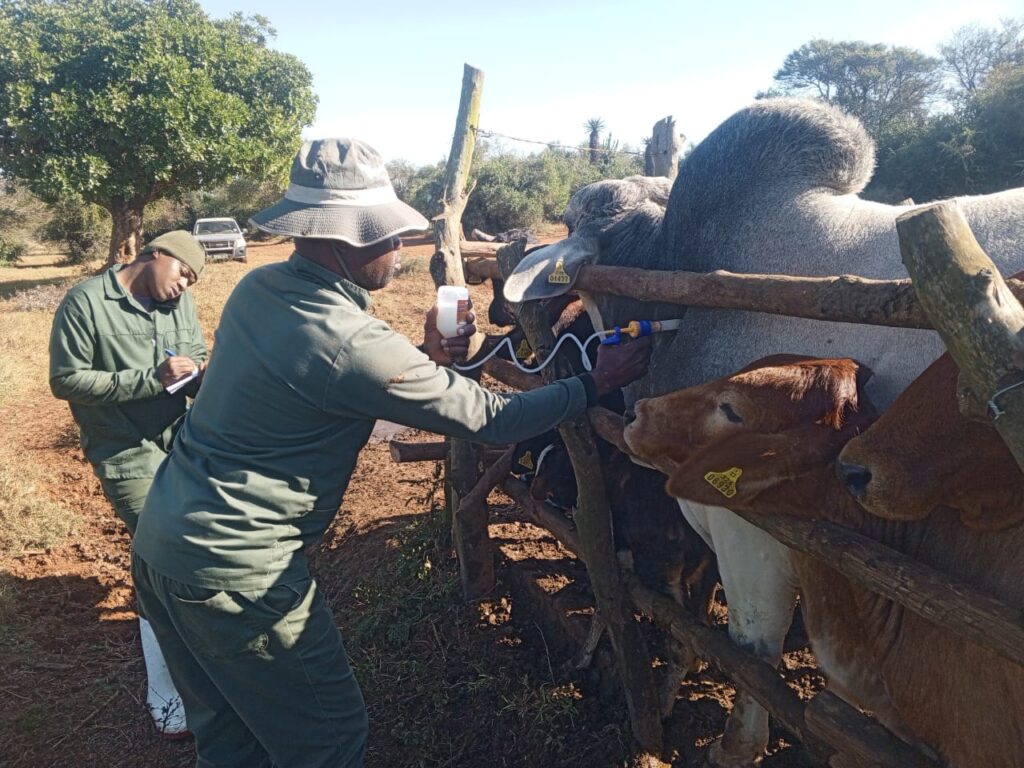
MBABANE (08.09.2026): The countdown to declare Eswatini Foot and Mouth Disease free has started. Unless a new FMD infection is reported between now and May 2027, Eswatini will declare FMD Free Without Vaccination status and resume oversees beef exports.
The path for the Kingdom to regain FMD free status is strengthened by the Hhohho Region which has remained FMD-Free and cattle from the region were not vaccinated in the 2025 national vaccination drive.
The Ministry of Agriculture had immediately launched a national vaccination programme and called for support from Botswana which supplied enough vaccines that were sufficient for the required two doses. All animals in dip tanks where the disease was reported in Shiselweni where the disease was first reported in May 2025 as well as in Lubombo and Manzini to which it quickly spread.


“In the areas where we vaccinated, we have not seen any new cases in the last six months,” confirmed Dr Thembi Ndlangamandla who leads the national FMD response in the Department of Veterinary and Livestock at the ministry of agriculture.
Eswatini is making sure to play it by the book. The country must impress the World Organization of Animal Health (WOAH) that it has followed all the steps to ensure that the outbreak is eradicated.
WOAH as the world regulator of animal health requires that the Director of Veterinary Services alerts the world community immediately of an FMD outbreak and to urgently design and submit a risk mitigation and implementation plan and control programme. Until a country provides verifiable proof that it has eradicated the disease, it is suspended from exporting its beef products. That suspension is only lifted after it undergoes a programme of strict compliance with the WOAH Progressive Control Pathway (PCP) that sets specific benchmarks and steps to be followed before WOAH in concert with the UN Food and Agriculture Organization and the European Union certify it FMD-Free.
The WOAH, EU and FAO tripartite maintains a register of what countries can export animal products and to what markets. Eswatini was one of the very few countries in the world that historically accessed the highly sought premium grass-fed FMD-Free Without Vaccination beef markets.
To ringfence this market, Eswatini implemented a detailed animal health information system that includes a livestock identification and traceability programme. Since 2001 this system ensures every animal has an ID number and is traceable for life. This way, every piece of steak landing on a dinner plate anywhere in the world can be traced back, not just to Eswatini but to a specific kraal and to the slaughtered animal.
It is now only a matter of time before Eswatini regains its FMD-Free Without Vaccination which certifies that its beef is clean from any of the hormones generated by vaccinated cattle.
“We have now completed taking blood samples to verify that there are no traces of the virus in Shiselweni where the disease first emerged, and in Lubombo to which it spread. We are now done with that,” says Dr. Ndlangamandla.
“We are now undertaking monitoring which is the third step in our FMD response. You can never say you have cleared the virus unless you have undertaken sustained monitoring to confirm all the animals are successfully inoculated. In the past 12 months since the second dose of vaccination was applied, our physical monitoring has continued to show no traces of FMD. Because of that we can now say we have eradicated the virus. Nevertheless, we continue to visit all the dip tanks in the areas where FMD was confirmed and take blood samples to test for antibodies.”
The kingdom which has been in lockdown now for almost 18 months since the disease encroached from KwaZulu Natal in May 2025, is crossing fingers that no new incident happens.
Dr. Ndlangamandla says since the country was only suspended but did not lose its status as an FMD-Free Without Vaccination beef exporter, it is assured of regaining that status after two years of showing evidence that it has contained and eradicated the disease.
“Within 2 years we must prove that we no longer have FMD. For the past 6 months we have not detected any antibodies in any of the vaccinated cattle. If we can maintain this record until May or June 2027, that should be enough for us to be removed from suspension.”
Dr. Ndlangamandla however admits that it is still too early to celebrate. “We need to be very careful in what we do from now going forward.”
On the ground, evidence of a relaxation of controls indicate rising confidence that the worst is now over. Road blocks that used to be manned by a multi-disciplinary task team of police, veterinary department staff, disaster preparedness and emergency and other departments have been trimmed. Now only a few men from MoA remain. These roadblocks were thrown around Shiselweni, Lubombo and Manzini soon after the disease outbreak. In recent months the checks were extended to all inbound roads traffic leading into Hhohho.
The Hhohho region has remained almost FMD-free throughout the epidemic and became a strong point of evidence showing national capacity to contain the disease. Hhohho livestock could potentially be in the front of the export queue once the country regains its place in the highly sought-after lucrative high value market in grass-fed FMD-free-without-vaccination beef.
The Ministry of Agriculture has also lifted restrictions of cattle and animal products from South Africa. Since August 2026, farmers can now import live cattle, goats and sheep from South Africa. The measure will be particularly important for feedlot operators who have been starved of feedstock since the FMD outbreak.
Every animal intended for export into the Kingdom will undergo a risk assessment before a permit is issued allowing it to enter Eswatini. Animals intended for the country will also undergo a 30-day quarantine in South Africa before crossing the border into Eswatini where it will be again quarantined for another 30 days for observation.
“We are being careful. We do not want to import the disease again,” explains Dr. Ndlangamandla.
In addition to the stringent import protocols, no livestock bought from cattle auctions in South Africa will be allowed into the country.
The FMD disaster has also been strangling the country’s fledgling dairy industry that relies on heifer imports from South Africa.
Imported livestock can only be used as breeding stock as only offspring born in Eswatini can be exported. Imported animals can only be slaughtered for domestic consumption.
Eswatini is not alone in the struggle against FMD. South Africa and Botswana are also currently battling with major FMD outbreaks. Mozambique has endured a permanent FMD crisis since 1974.
Eswatini’s area of most concern is the potential danger of a major setback by a new infections outbreak due to cattle or wildlife crossing the border from either KwaZulu Natal or Mpumalanga. Broken fences at Sikhwebezi near Hluthi in Shiselweni allowed cross-country cattle communal grazing to import the disease. Though that fence has been repaired, border fences are regularly broken and vandalized.
Jm/today/08.09.2026